
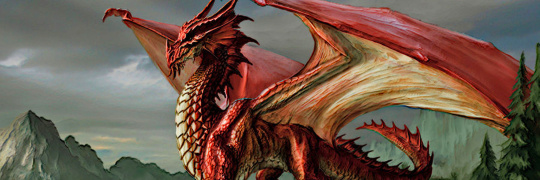
Physical Characteristics
Dragons are massive reptiles that are numbered among the largest creatures to ever inhabit Avonlea. They are a quadrupedal organism with each limb ending in long fingered claws. Their forelegs are more developed allowing more dexterous movements akin to arms, and each of their foreleg claws possess a clawed opposable thumb. Leathery wings protrude from their massive muscular backs allowing dragons to take flight. Their most prominent features are their long serpentine necks and prehensile tails.
These features can almost triple the length of the already titanic creature. Their tails can taper off into a point, but some are adorned with barbs, or a thick bone growth. Their heads are usually adorned by a crest that tapers down into their snout, with vertical slitted, forward facing eyes, showing that dragons are in fact predators.
Thick scales covered their bodies, varying size depending on their location or function. Their underbelly consists of thinner scales to allow for greater range of motion. While tough in their own right, these underbelly scales are comparatively weaker than those covering the rest of their body. Dragon scales come in a myriad of colors: natural shades of greens and browns, extremes of deep black and brilliant white, as well as rare hues of blue and red. While solid colors are possible, almost every dragon has unique patterning that, in addition to scent, allows them to be identified.
Dragons are innately magical creatures, and their strength causes them to be long lived. The stronger they are with magic the longer they live. Because of this, dragon births are rare, usually single eggs, that gestate up to a decade before hatching. At birth dragons are the size of large dogs. They grow quickly, molting frequently, during their juvenile phase which lasts the first century of their life. Dragons continue to grow throughout their entire lives. As an adult they can range in size from thirty up to one hundred meters in length. The adult phase can last up to five millennia. The rare individuals that manage to live beyond enter their elder wyrm phase of life. During which they continue to grow, but their scales lose the luster of youth.
Dragons are innately magical creatures and possess the ability to transform their physical body to resemble that of a humanoid. The ability is called Imprinting because wyrmlings are capable of doing it instinctively as a means of survival and camouflage. When a dragon transforms in this manner, they resemble a humanoid of above average height. When young they are hard to distinguish from other humanoids, but as they grow older, their true nature becomes more apparent.
The irises of their eyes become more vivid and betray their reptilian nature. Scales begin to grow along areas of their body such along their spines and collar bones, the back of knuckles and hands, and near joints, protecting them. Some dragons who have grown adept at the transformation can even manifest a set of functional wings when they transform. Wings, as magnificent as they may seem, become problematic when it comes to accommodating them.
Natural Habitat
Dragons are resilient creatures that can survive in nearly any environment as long as there is adequate food to sustain them. They have a resistance to extremes of temperature, so they can be found near active volcanoes or in frozen tundras. Most dragons, however, perfer to make their dens in areas with abundant plant and animal life, or in inaccessible mountain peaks. Dragons are very territorial in nature, and rarely congregate in large numbers.
Procreation
Dragons are very long lived creatures so their birth rate is extremely low. In order to be born a dragon, both parents must be dragons. Each pregnancy typically results in a single egg, with a rare occurrence of two eggs at once. In the event that a dragon procreates with another species the odds of yielding offspring are astronomical, bit in the event that it does happen, one species will be dominant. Since cross breeding is only possible in humanoid form, a dragon offspring will be born in its imprinted humanoid form for the survival of both mother and child.
Special Abilities
Dragons are innately magical creatures. Their scales are sought after as components for spells, rituals, and item creation. When they molt, their cast off skin can be used to create extremely durable yet supple protective items. When items are forged in the heat of a dragon’s fire, the material becomes more pliant and easier to enchant, resulting in a higher quality end product.
Breath Weapons: All dragon’s possess a heart flame which allows them to exhale the fiery breath that they are so well known for. This breath can get hot enough to melt metal and stone. Dragons who become skilled with using their magic in conjunction with their flame have been able to transmute the flame into another substance such as acid, poison gas, or even ice. The heart’s flame is not inexhaustible, so breathing fire takes its toll on the dragon. Drawing on one’s heart’s flame in excess can bring them close to death and without the strength to defend themself. Transmuting the breath is even more draining because it draws on both the life force as well as the magic to yield effect.
Strength: A dragon is a massive creature and has the strength proportional to its size. When in humanoid form, a dragon has strength roughly two to five times that of a humanoid the same size and build. How strong is mundaenly determined by how much effort they put into developing their humanoid body.
Imprinting: As a means of survival, a dragon can assume a humanoid form in order to move among humanoids. This is not an illusion, but a magical transformation. It is a drawn out and painful process that is not done lightly or frequently.
Resilience: Dragons are very hardy creatures that can survive in extreme environments. Their heart’s flame protects them from non magical heat, while keeping non magical cold from affecting them.
Weaknesses
While dragons are very sturdy long lived creatures, they are by no means immortal. They sustain damage like any living creature. Enough trauma will cripple, incapacitate, and eventually kill them. When dealing with dragons: strike first, strike hard, and keep striking until they stop moving.
Culture
Dragon culture is one of contradictions. It is in their nature to be very territorial and seek a solitude within their chosen domain. Surprisingly, they can be very social creatures. At the beginning of life there is a strong bond between mother and child. This bond has been known to continue after the wyrm reaches maturity and goes into the world to find a place of its own.
When two wyrms meet outside of their respective territories there is little to no hostility unless intentional. There are even rare gatherings of dragons that become cultural events. It is this contradiction that allows dragons to have a society. Their ruling body is a council of elder wyrms who have proven themselves wise enough to be revered by the society. This council convenes, debates important issues, and the majority consensus becomes the path for all dragons lest they become rogue and ostracize themselves from the group.
Their territorial tendencies are a result of an innate drive present in all dragons. Every dragon has within its soul a compulsion to collect and protect that which it assigns ultimate value to. There is no rhyme or reason to what this treasured commodity can be. It is a personal manifestation unique to each dragon. It may be something as simple as coins and gems or as ephemeral as songs. Whatever it may be, it is perceived and priceless to the dragon and they will defend it to the death. It normally hides its hoard somewhere in its territory, so any trespasser is met with aggression in order to drive them off, and keep the hoard safe.
History
Legend says that the first dragons were born from the molten heart of their mother, the planet itself. The first generation of dragons spread out to explore the far reaches of the new world. Even so new to the world, their avaricious natures were strong. They coveted the land itself, and as they grew, so too did their territory. When they began to breed, increasing their number, the world became a much smaller place. Eventually dragon-kind went to war with itself.
Because they are so long lived, the conflict played out over centuries, and each death was a loss for the entire species. Shorter lived species marked these dragon conflicts as if they were natural disasters changing the course of history. The wisest of the first dragons watched their children killing one another, and saw the threat of extinction looming over dragon kind if not stopped. This led to the formation of the First Eldwyrm Council.
Through decree and force of their might and magic, the Council gathered their children and bound their avarice inward. Instead of lusting after all things, and wanting to possess the world to the detriment of all, each dragon would lust after something it alone values. Thus the first War of Dragons ended and the legends of treasure hordes began.
Time marched on in peace. Elder Wyrms went into eternal slumber, becoming one with the Great Mother once more, passing the fate of Wyrm kind on to younger generations. Eventually the peace was shattered by the short lived races. Their kind had progressed over countless generations, growing stronger in the ways of magic as their knowledge grew. Their wars became more and more destructive until they brought catastrophe to the Great Mother, the planet herself.
Being creatures of ancient and powerful magic themselves that were closely tied to the planet, the dragons attempted to undo the damage done by mages, but were unable to. The very planet and magic itself had been thrown irreparably out of balance, and the damage only grew. Eventually that damage spread to the strongest of the Elder Wyrms before befalling all of the dragon kind.
In response to yet another threat of extinction, the Council of Wyrms convened to devise a way for dragons to survive the end of the world. It was decided that they would aid the other races in their creation of a safe haven in which to wait out the apocalypse. In return the mages would safeguard a collection of dragon eggs while the wyrms took their chances and tried to survive on their own without protection.
Omera’nya, a member of the council, was tasked with gathering as many viable eggs as she could, and delivering them safely to the sanctuary. It was a near impossible task, fighting through the great world ending storm of magic, while protecting such fragile charges, but she was successful. With the last of her strength, Omera’nya burrowed deep within the mountain upon which the mages built their Sanctuary, and deposited the eggs. With her task done and overwhelmed by her wounds, Omera’nya fell into a deep sleep and never woke again.
The mages proved true to their word and watched over the eggs and their sleeping guardian, passing the charge to each new generation for thousands of years. With the world’s magic in chaos, the natural life cycle of dragons was thrown into disarray, and none of the eggs hatched. Time passed, the wounds upon the world began to heal as magic calmed. The mages continued their vigil watching over the sleeping Mother Omera and the Last Rookery, waiting patiently. That is, until a crack formed in an egg, and the age of dragons began anew.